Source:Original SiteAuthor:Editor of this websiteRead: ReleaseDate:2019-08-30 15:45:27
Abstract:Hebi City-the Old Site of "Shilin Conference"
Shilin Town is located in the northeast of Hebi City, Henan Province. It is adjacent to Tangyin County in the East and Xilianshan District in the west. It is the east gate of Hebi City. There is a long history and strong cultural accumulation, simple folk customs, people live and work in peace, social stability and peace. It used to be the front gate of the liberated areas of Shanxi, Hebei, Shandong and Henan, and a part of the revolutionary base area of Taihang Mountains.
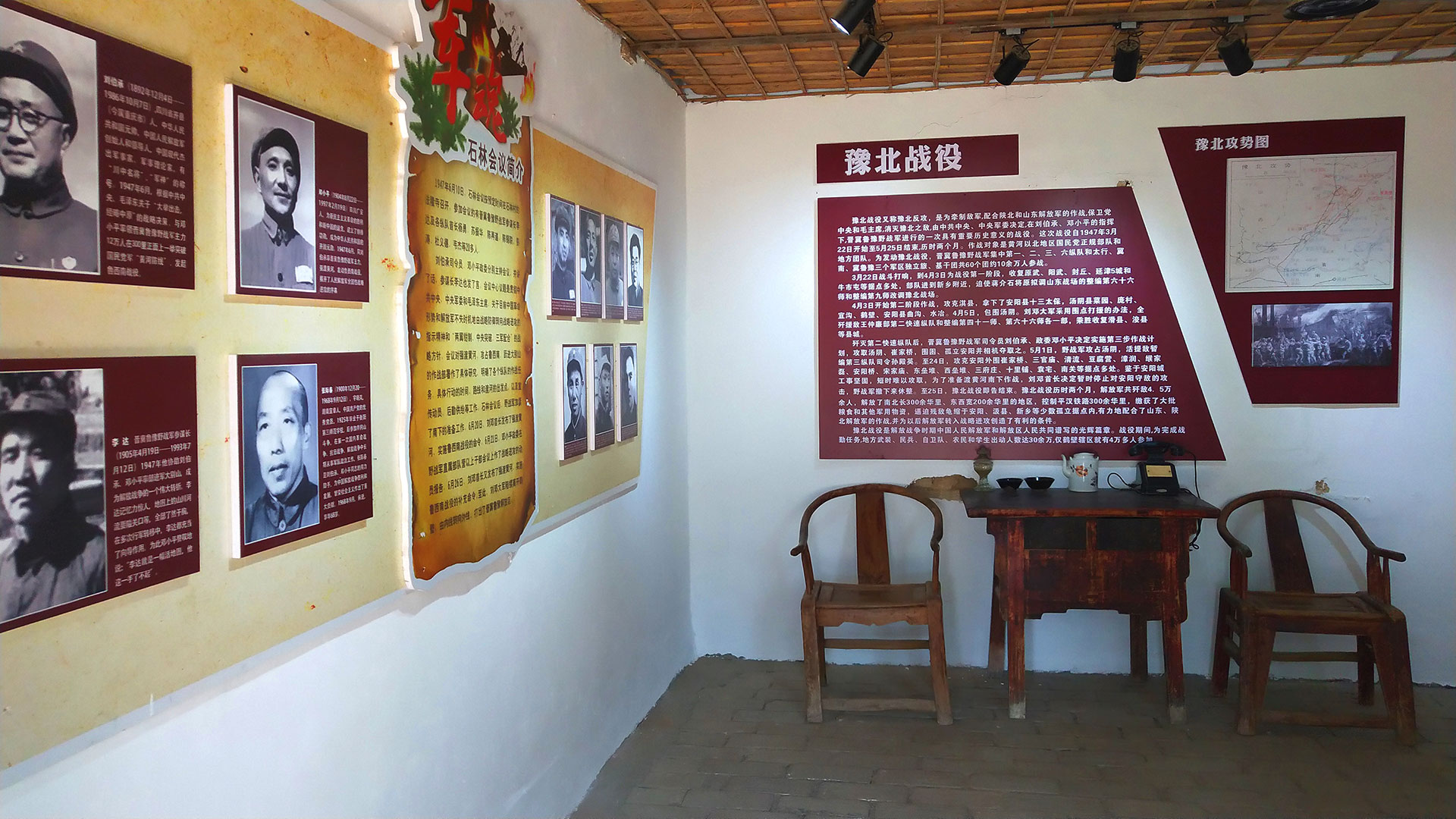
In Shilin Village, the old site of Shilin Military Conference was during the War of Liberation. Liu Deng's army leaped thousands of miles to chase the deer in the Central Plains. When Tangyin was liberated, the Shilin, which was only a few miles away from Tangyin, became the rear area. The headquarters of Liu Deng's army was located in Shilin, where they were stationed for 12 days and held the famous "Shilin Military Conference".
Shilin Township was located in the front gate of Shanxi-Hebei-Shandong-Henan Liberated Area during the War of Liberation, and it was a part of Taihang Mountain Revolutionary Base. On June 10, 1947, a very important conference of Shanxi-Hebei-Shandong-Henan Field Army, called "Shilin Conference", was held at Falong Temple in Hebi Shilin Township.
According to records, Falong Temple was built in the Tang Dynasty. Legend has it that in its heyday, there were many monks and great standards. The original monastery was a huge building complex covering an area of 30,000 square meters, about 300 meters north and south, 100 meters east and west. Monasteries and temples are abundant, with good fields of 100 hectares, and monks can reach more than 300 people at most. Not only that, even the large and small temples within ten miles of the surrounding area belong to the management of Falong Temple. Because there are many temples in this area, the village where Falong Temple is located is named "Shilin", and because of its homonym with "Shilin", the village name gradually evolved into "Shilin". Falong Temple has three main buildings from south to north. They are the Four Heavenly Kings Hall, the Buddha Hall and the Bodhisattva Hall. The three halls are on the same central axis, forming a symmetrical architectural pattern. The temple is large in scale. Blue brick and glazed color glitters in the sunshine, carved beams and painted buildings, flowing colors, Buddhist pagodas, and monuments. Stone-lined, pines and cypresses, flower clusters.
What is the background of the "Stone Forest Conference" held here? In February 1947, after the crushing of the overall offensive strategy of the Kuomintang army in the liberated areas, the Kuomintang authorities concentrated their superior forces and began to carry out the so-called key offensive. At this time, the war situation has changed in favor of the revolutionary forces, while the Kuomintang forces are trapped in the battlefields of Shandong and Northern Shaanxi, and the Kuomintang forces between the two battlefields are very empty, forming a dumbbell-shaped military layout of two strong and weak sides, which forms a dumbbell-shaped military layout for me. They have a very favourable situation. However, due to the destruction of production in many places in the hinterland of the Liberated Areas in the depth of the war, the Kuomintang ruling group took more brutal measures to suppress the patriotic democratic movement, to collect manpower, material and financial resources, and to continue to carry out key attacks on the Liberated Areas of Shandong and Northern Shaanxi in an effort to quickly end the war in these two areas and to divert its forces. In other battlefields.
In order to disrupt the enemy's deployment, in January 1947, the Central Committee of the Communist Party of China began to consider the issue of the Shanxi-Hebei-Shandong-Henan field forces dispatching to the Central Plains and transferring to the outside line. In the following months, the Central Committee of the Communist Party of China and the Central Military Commission gradually formed a "three-army cooperation, two wings holding the inside and outside lines" according to the progress of each battle situation. Closely cooperate with the strategic conception of. On May 4, 1947 and May 8, 1947, the Central Military Commission issued two telegrams instructing Liu Deng's army to strive for a strong crossing of the Yellow River in early June, to attack Southwest Shandong, Henan, Anhui and Soviet areas, and to attack the Central Plains in the second step. At this time, the army of Liu and Deng was launching a huge liberation campaign against the enemy in northern Henan, liberating Xinxiang, Junxian, Qixian, Hebiji and other places, and completing the siege of Anyang City. In order to implement the instructions of the Central Military Commission, the army of Liu and Deng was withdrawn from the battlefield of Anyang and renovated in Shilin. More than 20 people attended the meeting, including Chen Zaidao, Wang Jinshan, Chen Xilian, Wang Hongkun, Qin Jiwei, Du Yide, Xu Qian, Teng Daiyuan and Li Da, deputy commander of the field army. Liu Bocheng, Commander of Shanxi-Hebei-Shandong-Henan Field Army, and Deng Xiaoping, Political Committee, chaired a meeting of the heads of columns at Zhongfodian. The central theme was to implement the strategic policy of "two-wing control, central breakthrough, three-army cooperation" formulated by the Central Committee of the Communist Party of China, the Central Military Commission and Chairman Mao Zedong, and the seven experiences of the liberation of Tangyin in the second year. Military plans.
"Three armies cooperate with each other, two wings control each other, inside and outside lines cooperate closely", that is to say, Liu Bocheng and Deng Xiaoping commanded the four main columns of Shanxi-Hebei-Shandong-Henan field forces, and at the end of June, they crossed the Yellow River from the northern part of Henan Province, searched for and annihilated the enemy troops in the southwestern part of Shandong Province, and then gradually attacked the border areas of Henan-Anhui-Anhui to the north of the Yangtze River. To carry out the strategy, Chen Geng and Xie Fuzhi commanded the fourth, ninth and eighteenth columns of the Shanxi-Hebei-Shandong-Henan Field Army (Chen Xie's Army) to cross the Yellow River from southern Shanxi to Western Henan. They assisted Liu Deng's army in running the Central Plains, and Chen Yi and Su commanded the Western Field Army of East China (Chen Su's Army) and Shanxi-Hebei-Shandong-Shandong-Shanxi-Shanxi-Hubei border areas. The Eleventh Column of the Henan Field Army carried out its strategy in the Henan-Anhui-Jiangsu Border Region, cooperated with Liu Deng's army moving southward, and the Third Route Army launched in the shape of "Pin" to create a new Central Plains Liberated Area.


PublicNumber

Program
